When the Bell Replaces the Bugle: A Term in the Life of Britain's Veteran School Mentors
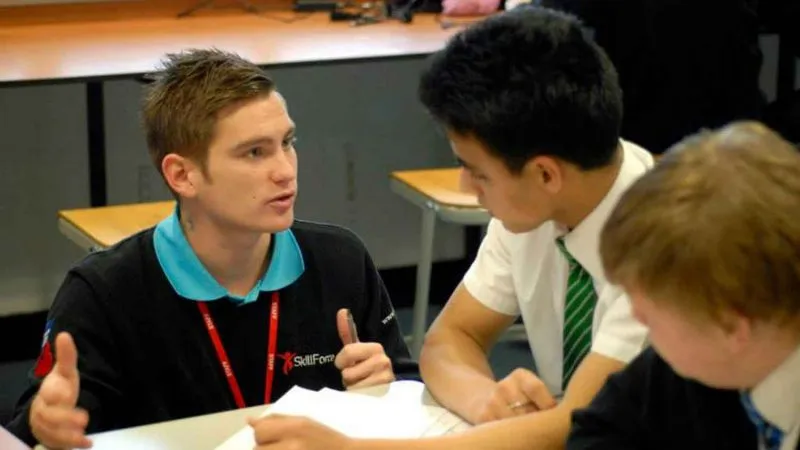
Photo: veteran mentor talking with teenage pupil in UK secondary school classroom, via www.forcesnews.com
The 8.40am bell at Kingsmead Academy does not sound like a regimental bugle, but for Simon Achebe it serves much the same purpose: a call to duty, precise and non-negotiable.
Simon spent twenty-two years in the British Army, including two tours of Helmand. Today, his uniform is a lanyard and a fleece, and his theatre of operations is a comprehensive school on the outskirts of Plymouth. He is one of a growing number of ex-service personnel volunteering as mentors in UK schools — a movement that has swelled quietly over the past decade and now, by sector estimates, places thousands of veterans in weekly contact with young people at risk of drifting.
A Different Kind of Deployment
Simon's Tuesday begins with a check-in with Jayden, a Year 10 pupil whose attendance had fallen below 60 per cent before the mentoring programme began. There is no formal agenda. They talk about Jayden's Saturday football match, his mother's new job, the coursework he has been avoiding. Simon listens the way the Army taught him to listen — patiently, without judgement, waiting for the thing beneath the thing.
"People assume we're here to bark orders," Simon says. "It's the opposite. These young people have had enough adults shouting at them. What they haven't had is someone who turns up every week, no matter what."
That consistency, veterans and educators agree, is the core of the offer. Punctuality, reliability and calm under pressure are habits drilled into service life, and they translate to the classroom with surprising ease.
What the Evidence Shows
Anecdote is one thing; outcomes are another. Schools running structured veteran-mentoring schemes report measurable improvements. At Kingsmead, pupils on the programme recorded an average attendance rise of eleven percentage points over two terms. Exclusion figures fell. Perhaps most strikingly, staff noted improvements in what teachers call "learning readiness" — the ability of a pupil to sit, focus and persist with difficult work.
Researchers studying resilience-based mentoring suggest several explanations. Veterans often model emotional regulation explicitly, talking openly about setbacks and recovery. Many bring practical goal-setting frameworks from their service careers. And crucially, some pupils respond to a mentor whose background differs sharply from the adults around them — someone who has faced genuine adversity and come through it.
The Recovery Nobody Talks About
For the veterans themselves, the benefit flows both ways. Occupational therapists working with veterans' charities have long observed that purpose-driven volunteering accelerates rehabilitation after service, particularly for those managing transition difficulties, injury or loss.
Simon is candid about this. "The first year out was the hardest of my life," he admits. "The structure, the mates, the mission — gone overnight. Standing in front of a classroom of kids gave me a reason to get up that felt like mine again."
In this sense, every mentoring session is a recovery story running in parallel with the one it supports. It is precisely the kind of dual-purpose initiative that charities working with veterans have begun to champion — yet it remains fragile.
An Overlooked Form of Service
Here lies the uncomfortable question at the heart of this movement: why is it so poorly resourced? Most veteran mentors volunteer unpaid. Programmes rely on short-term grants, school goodwill and the occasional philanthropic gift. There is no national framework, no dedicated funding stream, and no formal recognition of the hours contributed.
Advocates argue this is a false economy. The cost of supporting a trained veteran mentor is a fraction of the cost of exclusion, youth unemployment or the mental health interventions that may follow without early support. Some have called for mentoring hours to count towards formal recognition schemes for veterans, while others want local authorities to co-fund coordinator posts — the often-invisible glue holding these partnerships together.
The Last Bell of the Term
On the final Tuesday before the summer break, Simon watches Jayden collect a certificate for improved attendance at the school's awards assembly. The boy grins awkwardly. Simon claps a little too long, the way proud sergeant majors do.
"He'll be fine," Simon says afterwards. "They all can be. They just need someone who doesn't give up on them."
The bugle has been replaced by the bell. But the service, it seems, continues — one pupil, one Tuesday, one quiet act of duty at a time. If Britain is serious about honouring those who served, recognising this second parade might be the most natural place to start.