Four Paws, One Purpose: The Rescue Dogs Helping Veterans Find Their Way Back
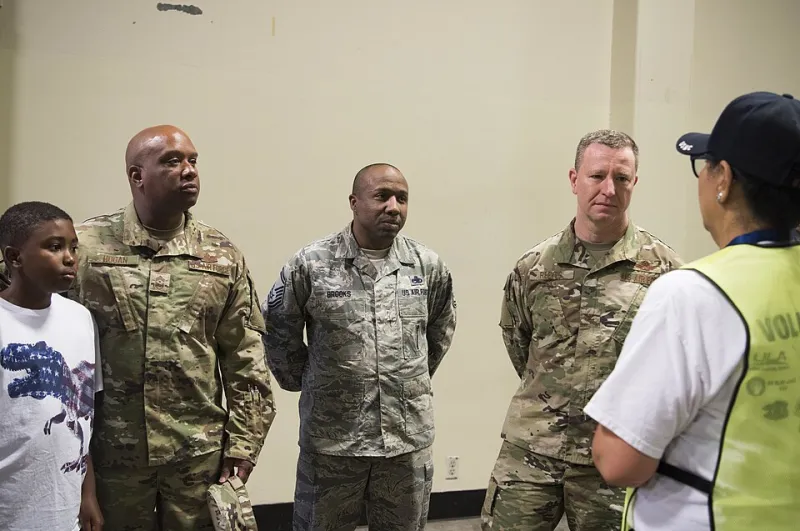
Photo: U.S. Air Force photo by Senior Airman Hanah Abercrombie, Public domain, via Wikimedia Commons
In a quiet training barn on the edge of Salisbury Plain, a lurcher-cross named Buster waits by a gate. He has waited here before — first as a stray in a Kent shelter, then as a trainee, and now as something rather more extraordinary: a companion to a man who once commanded a platoon in Helmand but who, until three months ago, had not queued in a supermarket without trembling.
A Meeting of Two Strays
Assistance dog charities working with the Armed Forces community have grown steadily over the past decade, and their central insight is disarmingly simple. Many veterans living with post-traumatic stress describe feeling safest with animals precisely because animals do not ask questions. A dog does not notice the sweating, the hypervigilance, the sudden departure from a crowded pub. A dog simply stays.
Buster's new handler, Gareth, a former Royal Engineer from Swindon, puts it plainly. "The dog doesn't judge. He doesn't flinch when I flinch. On the bad nights, he'll come and lie across my feet, and that's the first time in years I've slept past four o'clock."
Charities in this field typically source dogs from rescue centres — animals with difficult histories of their own — and match them to veterans after weeks of careful assessment. The pairing is treated less like a handout and more like a marriage: temperaments must fit, routines must align, and trust must be built gradually, off-lead in secure fields before ever venturing onto a high street.
Three Pairings, Three Beginnings
The journeys differ enormously. In Yorkshire, a spaniel named Wren has been trained to wake her handler — an Army medic medically discharged after a road traffic collision — from night terrors, nudging her awake and switching on a lamp by tugging a cord. In Portsmouth, a stocky Staffordshire bull terrier called Nelson blocks doorways on command, creating a buffer of space that his handler, a Falklands-era veteran, once could only find by standing with his back to a wall.
And there is Gareth and Buster, whose first public outing together was deliberately modest: a Tuesday morning at a garden centre outside Devizes. Charities describe these outings as graduation days. Volunteers shadow at a distance. The veteran holds the lead, the dog holds the lead's other end, and between them they cross a car park that might as well be no-man's-land.
Gareth managed eleven minutes before needing to return to the car. On the second attempt, a fortnight later, he stayed an hour and bought a bird feeder. "Everyone clapped when we came back to the training centre," he says. "I pretended to find it embarrassing. I didn't."
Why It Works
Clinicians remain careful not to overstate the case — assistance dogs complement, rather than replace, formal treatment such as trauma-focused therapy. But occupational therapists involved in these programmes point to measurable gains: fewer missed appointments, increased physical activity through daily walks, and a reduction in reliance on some medications.
There is also the matter of routine. Service life is built on structure, and its absence after discharge is one of the most commonly cited difficulties veterans face. A dog demands structure — feeding at seven, walks at noon and six — and quietly restores a rhythm to days that had lost theirs.
Then there is the social effect, subtle but profound. A veteran standing alone in a queue is invisible; a veteran with a handsome dog on a smart coat is approached, chatted to, asked questions. For people who have spent years avoiding conversation, the dog becomes a bridge back to the world.
The Cost of a Companion
Training and matching a single assistance dog can cost upwards of £20,000, taking close to eighteen months from rescue centre to veteran's front room. None of it is charged to the veteran. Every pairing depends on donations, legacies and community fundraising — which is precisely why stories like Gareth's matter beyond the heartwarming photograph.
Each of the three dogs featured here now wears a small brass tag on its collar, engraved with a single word: Onwards. It is, perhaps, the most honest summary of what these animals do. They do not cure. They do not forget. They simply sit vigil — through the night terrors, the crowded streets, the long quiet afternoons — until the person on the other end of the lead is ready to walk a little further than they did the day before.
For Gareth, the destination is already chosen. "The seaside," he says. "Buster's never seen the sea. Neither have I, not properly, not since I came home. We're going to do it together."