The Yarn Bomb Battalion: How a Veteran Knitting Circle in Yorkshire Is Stitching Together Recovery, One Row at a Time
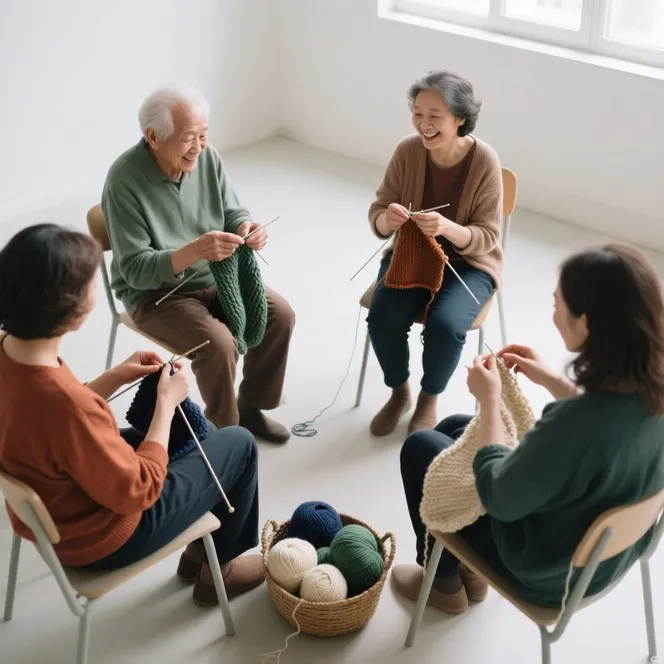
Photo: veterans knitting circle group wool hands close-up community hall, via images.stockcake.com
An Unlikely Squad Assembles
The first gathering, by all accounts, was a disaster. Eleven veterans sat in a circle at St Hilda's church hall in Morley, West Yorkshire, staring at one another over £3.99 balls of acrylic from the local market. Nobody knitted. Nobody, truth be told, particularly wanted to be there.
Three years on, the same circle — now numbering more than forty members — produces blankets, hats and comfort cushions for wounded service personnel recovering in hospitals from Selly Oak to Headley Court's modern successors. They call themselves, with typical forces humour, the Yarn Bomb Battalion.
"I came home from Afghanistan in one piece physically and fell apart quietly for a decade," says James Okafor, a former corporal in the Royal Electrical and Mechanical Engineers and one of the group's founders. "My wife saw a poster. I said knitting was for grannies. She signed me up anyway. Best thing that ever happened to me."
Why Wool Works
There is genuine science behind what looks, on the surface, like a quaint hobby. Occupational therapists have long observed that rhythmic, repetitive hand movements — knitting, crochet, whittling — can lower heart rate and reduce levels of cortisol, the body's primary stress hormone. For those living with post-traumatic stress disorder, the effect can be profound.
"The hands are occupied, the breathing slows, and the mind has nowhere to spiral," explains Dr Helen Marsden, a clinical psychologist who advises several veterans' charities. "It's a form of moving meditation. For hypervigilant brains, that's not a luxury — it's medicine."
The veterans themselves put it rather more plainly. "When I'm counting stitches, I'm not counting anything else," says Margaret Ellison, a former Army nurse who served in Bosnia. "Three years ago I couldn't sit in a room with my back to the door. Now I sit in a circle, twelve people behind me, and I'm fine. That's not wool doing that. That's trust."
From Awkward Silence to Second Family
Progress was slow. The early meetings were marked by long silences and dropped stitches. Several members admit they nearly gave up after the first session.
The turning point, organisers say, came when the group decided its output should have a purpose beyond the table. A member's nephew, a guardsman, was recovering from serious injuries at a military rehabilitation unit, and the circle sent him a hand-knitted blanket in regimental colours.
"The thank-you letter came back," Okafor recalls. "Read it aloud in the hall. Half of us had something in our eye we blamed on the dust. From that week, we weren't knitting. We were supplying the frontline of recovery."
Today, the Battalion's blankets reach wounded personnel through charity partners, and their comfort cushions — small, heart-shaped items that protect surgical sites and seatbelt injuries — are requested by name on some wards.
Wi-Fi, Wool and Wider Reach
When the pandemic forced the hall to close, the group did what the modern forces family does: it adapted. A video call now runs alongside every session, and members who struggle to leave the house — a common feature of PTSD — join from their kitchens.
"The Wi-Fi circle saved my life, I don't mind saying it," says one member who asked not to be named. "I hadn't spoken to anyone outside my house in eight months. First night, I sat there with the camera off, just listening to the clicking. Second week, camera on. Now I teach the beginners."
That hybrid model has since been borrowed by circles in Plymouth, Catterick and Inverness, forming a loose national network that shares patterns, wool donations and — more importantly — the quiet knowledge that no one recovers alone.
How You Can Help
The Battalion accepts donations of wool, particularly double knit in military and regimental shades, and welcomes beginners of any ability — including, they insist, those who have never held a needle. Financial contributions help cover postage for hospital deliveries and hall hire through the winter months.
"We stood beside our comrades in uniform," says Okafor, pausing to untangle a knot of sage-green wool. "Now we stand beside them in recovery. It turns out you can do both with the same pair of hands."
For a charity built on the principle of standing beside those who stood for us, there are few clearer illustrations. One stitch at a time, the Yarn Bomb Battalion is proving that recovery is rarely a solo march — and that sometimes the sharpest tools in the rehabilitation kit are the gentlest ones.